You do not need to become an expert in psychology, politics, law or media to protect your judgement, but you do need to know how each of those institutions influence you.
You need practical ways to recognise what is happening when:
a story is designed to make one conclusion feel inevitable
urgency is used to stop you asking questions
outrage replaces evidence
confidence is mistaken for credibility
a loaded question quietly controls the answer
social pressure makes disagreement feel unreasonable
someone gives you the feeling of deciding, while steering the decision
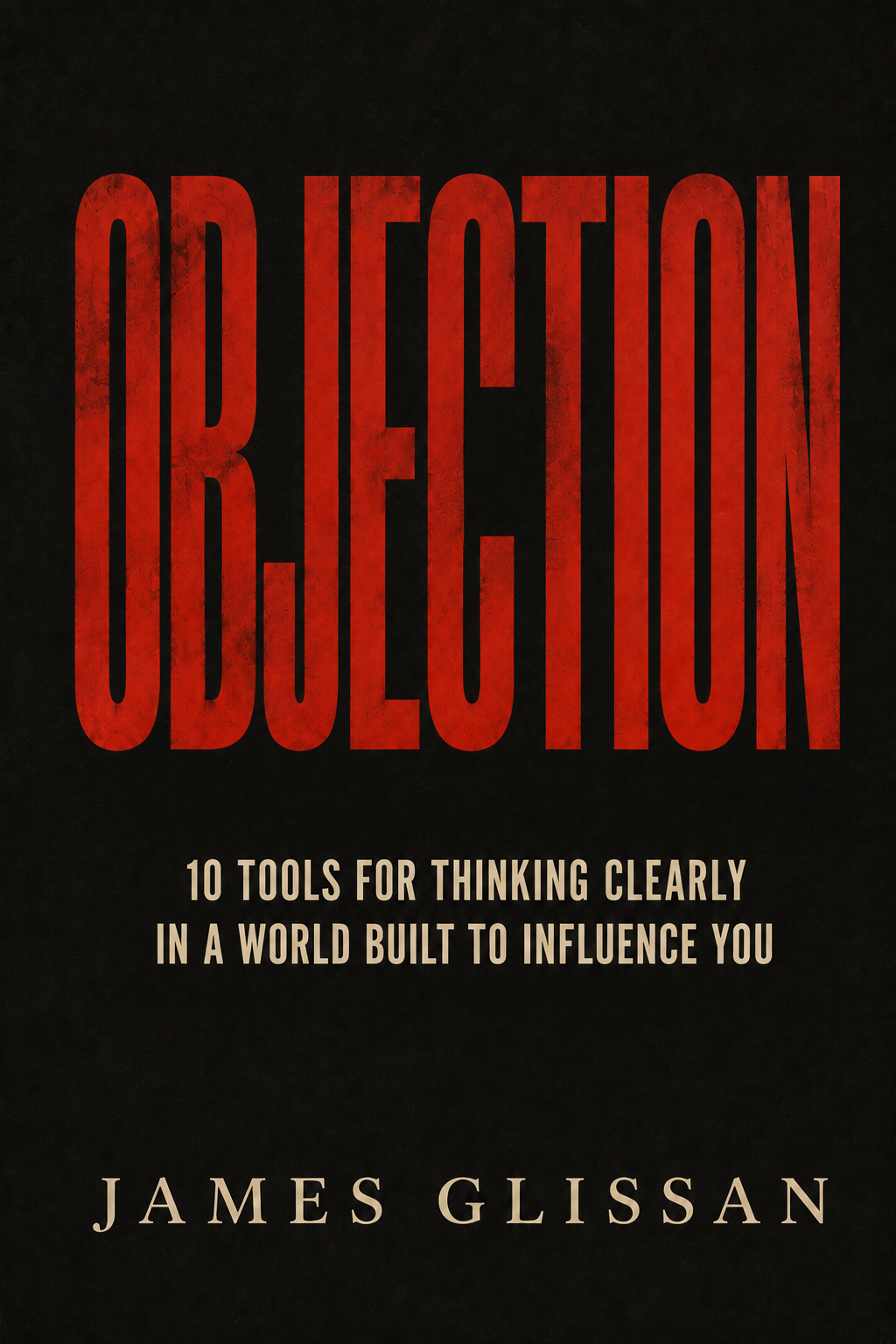
OBJECTION gives you ten tools to slow those moments down and decide what you actually think.
Think for Yourself
Before someone else does it for you…

PRESSURE
✦
EVIDENCE
✦
OUTRAGE
✦
FRAMING
✦
PERSUASION
✦
PRESSURE ✦ EVIDENCE ✦ OUTRAGE ✦ FRAMING ✦ PERSUASION ✦
BE HARDER TO MANIPULATE.
Recognise the move while it is being made.
Most of us can think of a time we realised, too late, that we had been led somewhere.
Maybe it was a conversation where the question had been set up so there was only one acceptable answer. A decision made in a hurry. A story that made you angry before you knew enough about it. A person who sounded certain and turned out to be wrong.
Usually there is a point afterwards where it becomes obvious. You can see the pressure, the framing, the part of the story that was left out. At the time, though, it is much harder. You are busy. You are invested. You want to trust the person in front of you, or everyone else seems to have already made up their mind.
None of these techniques is new. People have been finding ways to influence one another for as long as people have had something to gain. But the lessons are scattered across philosophy, psychology, law, politics, business and lived experience. Most people never get them gathered in one place, in a form they can remember when it counts.
That is what this book is for.
Ten Tools You Can Actually Use
IN THE REAL WORLD.
Most of us can think of a time we realised, too late, that we had been led somewhere.
Maybe it was a conversation where the question had been set up so there was only one acceptable answer. A decision made in a hurry. A story that made you angry before you knew enough about it. A person who sounded certain, and turned out to be wrong.
Usually there is a point afterwards where it becomes obvious. You can see the pressure, the framing, the part of the story that was left out. At the time, though, it is much harder. You are busy. You are invested. You want to trust the person in front of you, or everyone else seems to have already made up their mind.
We are surrounded by arguments pretending to be information.
Headlines, scandals, statistics, legal decisions, political announcements and public outrage all arrive with their framing already attached.
By the time most people hear about an issue, someone has already chosen the words, narrowed the question, selected the villain, hidden the incentives and told the audience where to look.
The trick is not always a lie. Often, the trick is what gets left out.
Objection is a field manual for seeing the machinery more clearly: power, persuasion, law, media, outrage, institutions and influence. Not as abstract theories, but as forces shaping everyday life.
The goal is not to tell you what to think.
The goal is to help you recognise the move while it is being made.
The aim is simple:
Give you the tools you need when a situation feels wrong, before you know you need them.
The book gives you a practical toolkit for:
Use them in conversations, news coverage, social media, workplaces, negotiations, sales pitches, political arguments and the decisions that matter most to you.
identifying the frame before accepting the argument
separating a claim from the feeling attached to it
testing whether evidence actually supports the conclusion
recognising pressure disguised as urgency, certainty or concern
finding the missing question in a persuasive story
understanding when a reaction is being engineered
keeping perspective when the incentives are pushing everyone towards the same answer
Update:
JOIN THE INTERESTED READERS LIST
September
Objection is now in its first editorial read-through, with Chapter 7 through that process.
It is becoming a deliberately short, practical book: something designed to be read, easily understood, remembered and used.
Join the Interested Readers List for occasional progress notes, behind-the-scenes updates and first notice when publication details are ready.
CURRENT STATUS
Editing
EXPECTED RELEASE
October 2026
ABOUT THE AUTHOR
James Glissan is an Australian solicitor, former police officer and former police prosecutor.
More recently, James has built one of Australia’s fastest-growing public legal education channels on YouTube, translating complex legal and institutional questions for a large and rapidly expanding audience.
OBJECTION distils more than a decade spent studying philosophy and law, policing the street, prosecuting cases, defending clients and running a business.
Those worlds may appear different, but the same questions keep returning.
How do people decide what is true?
What happens when emotion arrives before evidence?
How does the person controlling the frame influence the outcome?
Why do intelligent people accept weak arguments when pressure, identity or belonging is involved?
Objection brings those lessons together into one concise field guide: how to recognise the move, slow the moment down, test the claim and keep the decision yours.